Aging Changes That Can Be Hard to Accept — And Why That’s Okay
Getting older is a gift, but that does not mean it always feels easy.
For many adults over 65, some of the hardest parts of aging are not just the numbers on a birthday cake. It is the moment you notice it takes longer to get up from a chair, your balance is not quite what it used to be, or you feel more tired after doing things that once felt simple. Those changes can feel frustrating, emotional, and sometimes even unfair.
One of the biggest changes many older adults struggle with is the loss of physical strength. With aging, the body naturally loses muscle mass and power, which can affect mobility, endurance, and confidence. This age-related muscle decline is one reason everyday tasks like climbing stairs, carrying groceries, or walking long distances may become more difficult over time. Research also shows that aging is linked with declines in gait stability, muscle function, and exercise capacity, which can make people feel less steady and less independent.
Balance changes can also be hard to accept. Many older adults notice they move more slowly, feel less steady, or become more cautious about falling. That fear is understandable. Age-related balance changes are influenced by several factors, including musculoskeletal, sensory, and neurologic changes, and they can affect confidence just as much as physical safety.
Changes in appearance can also be emotional. Thinner skin, wrinkles, gray hair, changes in body shape, and a loss of muscle tone may seem minor to others, but they can deeply affect self-image. Vision and hearing changes may also feel especially difficult because they can interfere with reading, driving, conversations, and social activities. When these changes start to affect independence, they can feel like much more than “normal aging.”
The truth is that many older adults are not upset simply because their bodies are changing. They are upset because those changes can feel like a loss of freedom, routine, and identity. That reaction is normal, and it deserves compassion.
The good news is that healthy aging still matters. Staying active, eating well, keeping up with preventive care, and speaking openly about physical changes can all help older adults maintain strength, function, and quality of life. Aging may bring change, but it does not take away a person’s worth, dignity, or ability to live meaningfully.
Can Anti-Aging Supplements Really Turn Back the Clock? What You Should Know
If you’ve ever seen an ad for a supplement that promises to help you feel younger, boost your energy, sharpen your memory, or even “slow aging,” you are definitely not alone. These products are everywhere online, and they can be very tempting—especially when they speak to real concerns like staying independent, active, and mentally sharp as we get older.
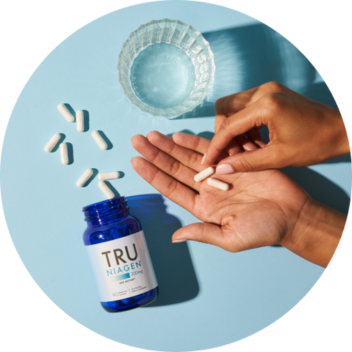
One product you may come across is Tru Niagen, a supplement that contains nicotinamide riboside (NR). It is marketed as a way to support “healthy aging” by increasing NAD+, a body compound involved in cellular energy and repair. That sounds impressive—but here’s the big question: does it actually slow aging?
What the research really says
Right now, the answer is not really—not in the way the ads may make it seem.
Some studies do show that nicotinamide riboside can increase NAD+ levels in the body. But that does not automatically mean it slows or reverses aging. In a recent study of older adults with mild cognitive impairment, researchers found that while the supplement raised NAD+ levels, it did not improve cognition, and they said more research is needed before making strong claims about healthy aging benefits (Orr et al., 2023).
Another recent review looked at NAD+-boosting supplements in humans and found that while they may be safe for many people in the short term and can change certain biomarkers, the evidence that they improve real outcomes like strength, memory, physical function, or overall healthy aging is still limited and inconsistent (Freeberg et al., 2023).
So in simple terms:
It may change a lab number, but that does not mean it has been proven to make you age more slowly.
Don’t let testimonials fool you
One of the biggest reasons these products sell so well is because of testimonials.
You’ve probably seen them:
- “I feel 10 years younger!”
- “I have so much more energy!”
- “This changed my life!”
Those stories can be very convincing, but it’s important to remember that testimonials are not the same as research.
A testimonial is one person’s experience. It may be real, but it doesn’t prove the product works. People can feel better for lots of reasons—better sleep, diet changes, exercise, placebo effect, or simply hoping the product will help.
Research, on the other hand, looks at:
- how many people were studied,
- whether there was a placebo group,
- how long they took the product,
- and whether it actually improved health in a meaningful way.
If a company relies mostly on glowing reviews but has very little strong scientific evidence, that’s a sign to be cautious.
How can you tell if the claims are valid?
Before buying any “anti-aging” product, ask yourself these questions:
1. Is it a supplement or an FDA-approved medication?
Tru Niagen is a dietary supplement, not an FDA-approved drug. That means it is not reviewed by the FDA the same way prescription medications are before being sold.
2. Does it improve real health outcomes?
Ask:
- Does it improve memory?
- Does it improve strength or balance?
- Does it reduce frailty or falls?
- Or does it just improve a lab marker?
That difference matters.
3. Are there side effects or medication interactions?
Even “natural” products can cause problems. Older adults often take several medications, and supplements can interact with blood pressure medicines, diabetes medications, or blood thinners.
4. Where is the evidence coming from?
Don’t rely only on the company website. Better places to check include:
- PubMed
- Google Scholar
- National Institute on Aging
- FDA
- Mayo Clinic
- your pharmacist, nurse practitioner, physician, or nurse
My advice: Be curious, but be cautious
Based on what we know right now, I would not recommend Tru Niagen as a proven anti-aging supplement. The current research does not show strong evidence that it truly slows, stops, or reverses aging in older adults. It may raise NAD+ levels, but that is not the same as improving the things that matter most—like memory, mobility, strength, or independence (Freeberg et al., 2023; Orr et al., 2023).
That doesn’t mean every person who tries it will have a bad experience—but it does mean the marketing is stronger than the science right now.
The nurse’s role: supporting the person, not just judging the product
As nurses, we know these products are not just about “buying a supplement.” Often, they are about something deeper.
Many older adults are worried about:
- losing independence,
- feeling weaker,
- memory changes,
- chronic illness,
- or simply feeling like their body is changing in ways they don’t like.
Those feelings are real, and they deserve compassion.
Instead of dismissing someone for wanting to try an anti-aging product, nurses can:
- listen without judgment,
- explain what the science does and does not show,
- review safety concerns and interactions,
- and help redirect attention toward what truly supports healthy aging.
The truth is, the most evidence-based “anti-aging plan” still includes:
- strength training and regular movement
- healthy sleep
- balanced nutrition
- staying socially connected
- managing chronic conditions
- medication reviews
- fall prevention
- brain stimulation and meaningful activity
These may not sound as exciting as a miracle supplement, but they have much stronger evidence behind them.
Final thoughts
If a product promises to “turn back the clock,” take a pause before clicking buy now.
Ask questions. Look for real research. Talk with a trusted healthcare professional.
Healthy aging is absolutely possible—but it usually comes from daily habits, good medical care, and informed choices, not a bottle that promises miracles.
References:
Freeberg, K. A., Udovich, C. C., Martens, C. R., Seals, D. R., & Craighead, D. H. (2023). Dietary Supplementation With NAD+-Boosting Compounds in Humans: Current Knowledge and Future Directions. The Journals of Gerontology. Series A, Biological Sciences and Medical Sciences, 78(12), 2435–2448. https://doi.org/10.1093/gerona/glad106
Grevendonk, L., Connell, N. J., McCrum, C., Fealy, C. E., Bilet, L., Bruls, Y. M. H., Mevenkamp, J., Schrauwen-Hinderling, V. B., Jörgensen, J. A., Moonen-Kornips, E., Schaart, G., Havekes, B., de Vogel-van den Bosch, J., Bragt, M. C. E., Meijer, K., Schrauwen, P., & Hoeks, J. (2021). Impact of aging and exercise on skeletal muscle mitochondrial capacity, energy metabolism, and physical function. Nature Communications, 12(1). https://doi.org/10.1038/s41467-021-24956-2
Orr, M. E., Kotkowski, E., Ramirez, P., Bair-Kelps, D., Liu, Q., Brenner, C., Schmidt, M. S., Fox, P. T., Larbi, A., Tan, C., Wong, G., Gelfond, J., Frost, B., Espinoza, S., Musi, N., & Powers, B. (2023). A randomized placebo-controlled trial of nicotinamide riboside in older adults with mild cognitive impairment. GeroScience. https://doi.org/10.1007/s11357-023-00999-9
Rezaei, A., Bhat, S. G., Cheng, C.-H., Pignolo, R. J., Lu, L., & Kaufman, K. R. (2024). Age-related changes in gait, balance, and strength parameters: A cross-sectional study. PLoS ONE, 19(10), e0310764–e0310764. https://doi.org/10.1371/journal.pone.0310764
Song, Q., Zhang, X., Mao, M., Sun, W., Zhang, C., Chen, Y., & Li, L. (2021). Relationship of proprioception, cutaneous sensitivity, and muscle strength with the balance control among older adults. Journal of Sport and Health Science, 10(5), 585–593. https://doi.org/10.1016/j.jshs.2021.07.005
Wang, J., Li, Y., Yang, G.-Y., & Jin, K. (2024). Age-Related Dysfunction in Balance: A Comprehensive Review of Causes, Consequences, and Interventions. Aging and Disease, 16(2). https://doi.org/10.14336/ad.2024.0124-1



No comments:
Post a Comment