Wednesday, April 1, 2026

Alzheimer’s Disease: What Families Should Know (and How to Keep Life Meaningful)

 Alzheimer’s Disease & Dementia Treatment

Alzheimer’s disease is the most common cause of dementia, but it is not a normal part of aging. It is a progressive brain disorder that slowly affects memory, thinking, behavior, and the ability to do everyday tasks. For families, it can feel overwhelming at first—but understanding the disease and focusing on quality of life can make a huge difference.

What Causes Alzheimer’s Disease?

Alzheimer’s disease develops because of abnormal changes in the brain. The two main changes researchers talk about are:

  • Amyloid plaques (protein clumps that build up between brain cells)
  • Tau tangles (abnormal twisted proteins inside brain cells)


These changes damage neurons and make it harder for brain cells to communicate. Over time, this leads to memory loss, confusion, and a decline in daily functioning. Researchers also believe that age, genetics, inflammation, and vascular health (like high blood pressure, diabetes, and high cholesterol) can all play a role in how Alzheimer’s develops and progresses. Recent reviews continue to describe Alzheimer’s as a complex disease with multiple contributing causes rather than one single trigger (Wang et al, 2025).
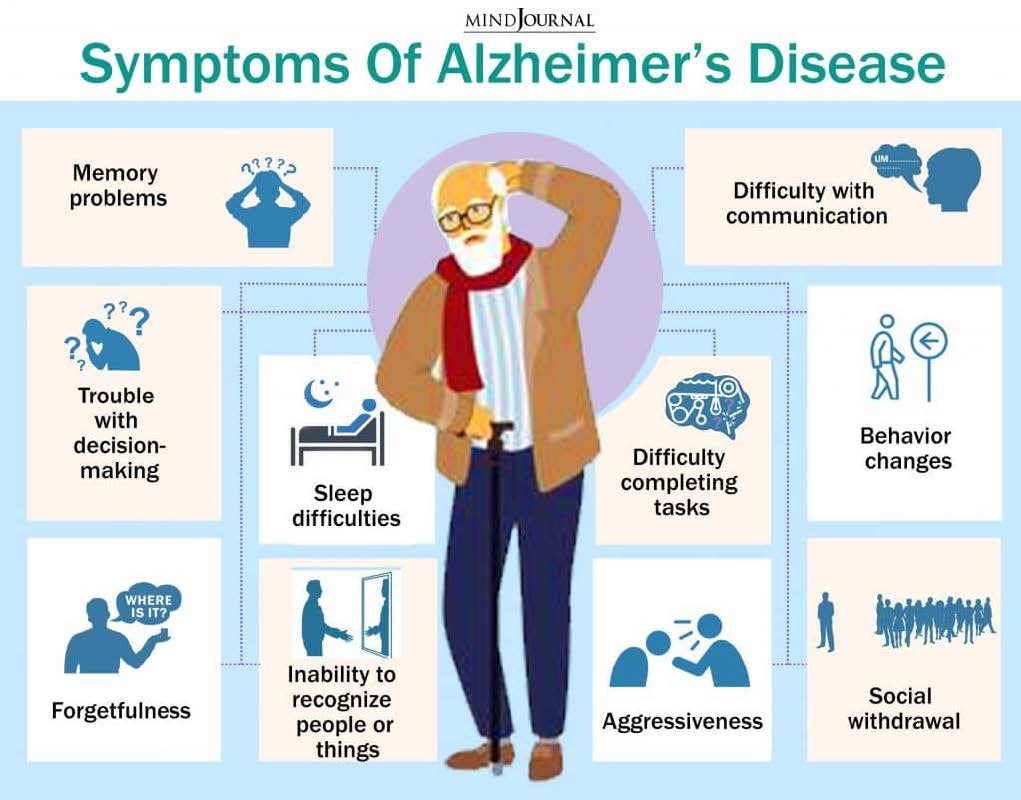

alzheimer's symptoms

Common Symptoms of Alzheimer’s Disease

Alzheimer’s usually starts gradually. Early symptoms may seem mild at first, but they become more noticeable over time.

Common early symptoms include:

  • Forgetting recent conversations or appointments
  • Repeating the same questions
  • Misplacing items often
  • Trouble finding the right words
  • Difficulty managing medications or bills
  • Getting confused about dates, places, or routines

As the disease progresses, symptoms may include:

  • Increased confusion and disorientation
  • Wandering or getting lost
  • Mood or personality changes
  • Sleep disturbances
  • Difficulty bathing, dressing, or eating
  • Trouble recognizing loved ones in later stages
Treatment Options: Medications and Non-Drug Approaches

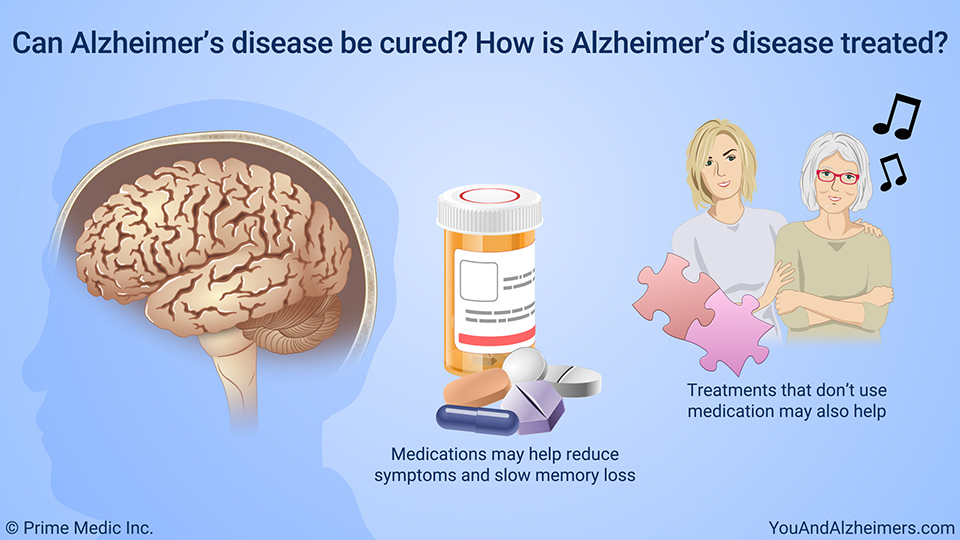
There is currently no cure for Alzheimer’s disease, but treatment can help slow symptoms or improve daily functioning.

Pharmacological (Medication) Treatments

Common medications include:

  • Donepezil (Aricept)
  • Rivastigmine (Exelon)
  • Galantamine (Razadyne)
  • Memantine (Namenda)

These medications may help with memory, attention, or behavior for some individuals.

Newer medications, such as anti-amyloid, are designed to target amyloid in early Alzheimer’s disease. These drugs may slow the decline in select patients, but they do not reverse the disease and require careful monitoring because of possible side effects such as brain swelling or bleeding (Wang et al, 2025).

Non-Pharmacological Treatments

These are often just as important—and sometimes even more helpful for daily quality of life.

Examples include:

  • Exercise programs
  • Cognitive stimulation
  • Music therapy
  • Structured daily routines
  • Social engagement
  • Environmental safety changes
  • Caregiver education and support

Recent evidence shows that non-drug interventions can improve cognition and daily function, especially in mild-to-moderate Alzheimer’s disease, with exercise-based interventions showing some of the strongest benefits (Chen et al, 2025).

Here is a website you could explore for physical activity and exercise ideas: https://www.alzheimers.org.uk/get-support/living-with-dementia/exercise-types-ideas


No photo description available.

The Most Important Part: How to Promote Health, Well-Being, and Quality of Life

This is the part families need most—because even though Alzheimer’s changes memory, quality of life can still be protected.

1. Keep Life Predictable

People with Alzheimer’s usually do better with a consistent routine.

Try to keep:

  • Wake-up time the same
  • Meals at regular times
  • Medications on schedule
  • Bathing and bedtime routines consistent

Why it helps: Familiar routines reduce anxiety, confusion, and agitation.

Simple idea: Use a large whiteboard or calendar with the day’s plan.

2. Make the Home Safer Without Taking Away Dignity

Safety matters, but the home should still feel like a home—not a hospital room.

Helpful safety changes:

  • Remove loose rugs and clutter
  • Improve lighting in hallways and bathrooms
  • Install grab bars
  • Use non-slip mats
  • Lock up medications and cleaning products
  • Consider door alarms if wandering is a concern
  • Use a medical alert bracelet or ID card

Big tip: Simplify the environment instead of over-controlling it.

3. Keep the Person Moving

Physical activity is one of the best non-drug strategies for maintaining function and mood.

Great options:

  • Short daily walks
  • Chair exercises
  • Stretching
  • Light dancing
  • Supervised balance exercises

Exercise may help with:

  • Mood
  • Sleep
  • Restlessness
  • Strength and mobility
  • Overall function

Recent research found that nonpharmacologic interventions—especially exercise therapy—can improve cognitive outcomes in older adults with mild-to-moderate Alzheimer’s disease (Chen et al, 2025)


4. Focus on Meaningful Activities, Not “Perfect” Memory

Even if memory is changing, people with Alzheimer’s can still enjoy connection and purpose.

Ideas that often work well:

  • Looking through old photos
  • Listening to favorite music
  • Folding towels or sorting simple items
  • Gardening
  • Coloring or easy crafts
  • Prayer, devotional time, or church music
  • Talking about happy life memories

The goal is not to “test” memory. The goal is comfort, familiarity, and connection.

5. Protect Nutrition, Hydration, and Sleep

People with Alzheimer’s may forget to eat, drink, or rest.

Helpful strategies:

  • Offer small, simple meals
  • Use finger foods if utensils become frustrating 
  • Encourage fluids throughout the day
  • Keep caffeine low later in the day
  • Reduce evening overstimulation
  • Use nightlights to reduce nighttime confusion

These small changes can prevent dehydration, weakness, worsening confusion, and falls.

6. Support the Caregiver, Too

Caring for someone with Alzheimer’s can be physically and emotionally exhausting. Families often try to do everything alone—and that usually is not sustainable.

Caregiver support ideas:

  • Join a support group
  • Use respite care
  • Rotate caregiving tasks among family members
  • Keep a medication and appointment binder
  • Ask the provider about home health or social work referrals

Reminder: Asking for help is not giving up. It is part of good caregiving.

Take a look! This website has more information on how to avoid burnout as a caregiver and other resources: https://www.myalzteam.com/resources/managing-caregiver-burnout-and-alzheimers

Local Resources for Families in St. Cloud / Osceola County / Central Florida

Alzheimer's Association - Central & North Florida Chapter

Address: 2170 W State Rd 434 #300, Longwood, FL 32779
Phone: (407) 951-7992
Website: Alzheimer’s Association Central & North Florida
Services: 24/7 helpline, caregiver support groups, education classes, community programs, care navigation, and dementia resources for families across Central and North Florida. The chapter serves 43 counties in the region.

Alzheimer's & Dementia Resource Center

Address: 1470 Gene St, Winter Park, FL 32789
Phone: (407) 436-7750
Website: http://www.adrccares.org
Services: Caregiver support groups, counseling, education, dementia care planning, workshops, and community referrals for families coping with Alzheimer’s and related dementias.

Osceola Council on Aging

Address: 700 Generation Point, Kissimmee, FL 34744
Phone: (407) 846-8532
Website: Osceola Council on Aging
Services: Transportation, meals, adult day health services, home care, senior support services, and programs that can help families caring for an older adult with dementia at home.

Senior Resource Alliance

Address: 3319 Maguire Blvd, Suite 100, Orlando, FL 32803
Phone: (407) 514-1800
Elder Helpline: 1-800-963-5337
Website: Senior Resource Alliance
Services: Caregiver support, long-term care referrals, aging and disability resource services, SHINE Medicare counseling, and community programs for older adults in Osceola, Orange, Seminole, and Brevard counties.


Final Thoughts

Alzheimer’s disease affects memory and thinking, but it does not take away the need for dignity, comfort, and connection. Medications can help some people, especially early on, but daily routines, safety, exercise, meaningful activities, and caregiver support often have the biggest impact on quality of life. Families do not have to do this alone—and with the right support, people living with Alzheimer’s can still have moments of joy, purpose, and peace.

References:

Chen, K., Zhao, X., & Zhou, J. (2025). Effect of a single nonpharmacological intervention on cognitive functioning in older adults with mild-to-moderate Alzheimer’s disease: A meta-analysis of randomized controlled trials. The Journal of Prevention of Alzheimer’s Disease12(3), 100050. https://doi.org/10.1016/j.tjpad.2024.100050


‌Touhy, T. A., & Jett, K. (2022). Toward Healthy Aging: Human Needs and Nursing Responses (11th ed.). Elsevier


Wang, S., Xu, H., Liu, G., & Chen, L. (2025). Non-pharmacological treatment of Alzheimer’s disease: an update. Frontiers in Aging Neuroscience17. https://doi.org/10.3389/fnagi.2025.1527242

Tuesday, March 31, 2026

Making Space for an Older Adult at Home: A Family Guide


A New Chapter for the Whole Family

If I had to share my home long-term with a parent or grandparent, the biggest thing that would probably bother me is the loss of privacy and how much our normal routine would change. I think a lot of people feel guilty admitting that, but it is real. Even when you love someone deeply, adding another person to the household full-time changes everything—sleep schedules, bathroom use, meals, quiet time, finances, and even emotional energy. It can also be hard when the person moving in used to be independent and now needs help.

In my household, we have a busy family routine and limited extra space, so a parent or grandparent moving in would require some major changes. We would need to create a safe bedroom on the first floor, remove tripping hazards, and make the bathroom safer with grab bars, non-slip mats, and possibly a shower chair. We would also need to talk openly about who would help with medications, transportation, meals, and appointments. Most importantly, we would need to talk about boundaries before stress starts building. Family caregivers provide most of the long-term support for older adults, but many families feel unprepared for the emotional and physical demands of caregiving, which is why planning ahead matters so much (Wolff et al., 2016).

A multigenerational family where the senior has just moved in, highlighting the idea of whether a senior should live with his adult children

How Family Structure Changes the Experience

1. Single-Parent Household

A single-parent household may have the biggest challenge because one person may already be balancing work, parenting, and all household responsibilities. Adding an older adult can increase stress quickly, especially if the older adult needs help with mobility, medications, or personal care.

In this kind of family, outside support becomes very important. Respite care, adult day programs, meal delivery, and home health services can help prevent caregiver burnout and make the arrangement more sustainable.

2. Married Couple With Children

A married household with children may have more people to share responsibilities, but it can also create “sandwich generation” stress—caring for children and an aging parent at the same time. This can lead to tension over time, space, finances, and emotional energy.

For these families, organization is key. A shared calendar, chore division, and regular family check-ins can help keep everyone on the same page and prevent resentment from building.

3. Adult Couple or Single Adult Without Children at Home

A home with only adults may be quieter and more flexible, which can make the transition smoother. However, there may be fewer built-in helpers if the older adult needs hands-on care or supervision.

In these households, the risk is often caregiver overload. Even if the environment is calmer, one or two people can still become exhausted over time. This is where community resources and realistic care planning are essential.


Getting Your Home Ready For Your Parents

What Every Family Needs to Think About Before the Move

No matter what the family looks like, there are some important questions every household should ask before an older adult moves in:

Questions to Ask

  • What level of care does the older adult really need?
  • Can they safely bathe, dress, toilet, and manage medications?
  • Do they have dementia, fall risk, hearing loss, or mobility limitations?
  • Who will be the main caregiver?
  • What happens if that caregiver gets sick, works late, or burns out?
  • Is this a short-term recovery plan or a long-term living arrangement?
  • How will expenses be handled?

Home Modifications That May Be Needed

To make the home safer and more comfortable, families may need to:

  • Remove loose rugs and clutter
  • Improve lighting in hallways and bathrooms
  • Install grab bars in the bathroom
  • Use a shower chair and non-slip mats
  • Move the older adult to a first-floor bedroom
  • Add a raised toilet seat or bedside commode
  • Use a pill organizer or locked medication box
  • Consider a medical alert system

These small changes can reduce fall risk and help the older adult stay as independent as possible.

Home safety tips for older adults infographic, click transcript below

Here is a website that goes into detail about other home modifications you can make:
https://carex.com/blogs/resources/aging-in-place-home-modifications?srsltid=AfmBOorhrwDbd680cfr7FECBdkoAjs7JEy1Bx-MTN-W8zOp4Prq8kl_D

Potential Areas of Conflict—and Real Ways to Prevent Them

Privacy

Older adults still need dignity and personal space.

Ways to reduce conflict:

  • Give them their own room if possible
  • Knock before entering
  • Let them decorate their own space
  • Use a “Do Not Disturb” sign when they want privacy or have visitors
  • If appropriate, consider a lock on the bedroom or bathroom door

Loss of Independence

Families sometimes start doing too much too quickly, which can make the older adult feel powerless.

Ways to reduce conflict:

  • Let them do what they can still do safely
  • Offer choices instead of taking over
  • Ask, “How would you like this done?”
  • Encourage participation in daily routines

Household Routine Differences

Different sleep schedules, TV volume, meal preferences, and bathroom timing can cause frustration.

Ways to reduce conflict:

  • Create shared expectations for meal times and quiet hours
  • Use a family calendar for appointments and routines
  • Talk about expectations early, not during an argument

Caregiver Stress

Even loving families can become overwhelmed.

Ways to reduce conflict:

  • Hold a monthly family meeting
  • Rotate caregiving tasks when possible
  • Schedule breaks for the main caregiver
  • Use respite services before burnout happens

Research shows that family caregiving can create emotional, physical, and financial strain, especially when families lack adequate support and planning (Wolff et al., 2016).

Conflict

Local Resources for Families in Osceola County / St. Cloud, Florida

If your family is in Central Florida, these local resources can really help with the transition:

  • Osceola Council on Aging – transportation, health clinic, adult day health care, home care, housing, and home safety support
    700 Generation Point, Kissimmee, FL 34744
    Phone: (407) 846-8532
    The organization offers transportation, adult day health care, home care services, and home rehabilitation support for older adults in Osceola County.
  • Senior Resource Alliance (serves Osceola County) – caregiver resources, long-term care referrals, SHINE Medicare help, Elder Helpline
    Phone: (407) 514-0019
    Statewide Elder Helpline: 1-800-963-5337
    Senior Resource Alliance serves Central Florida as the Aging and Disability Resource Center and connects families to caregiver and long-term care support.
  • Florida Elder Helpline – a great first step for statewide elder services
    1-800-963-5337
    The Florida Department of Elder Affairs lists Osceola County’s Elder Helpline access through 407-514-0019 and the statewide line 1-800-963-5337. 
  • Healthy Seniors Initiative (Osceola County) – rental assistance, eyeglasses, denture help, wellness programs
    Phone: (407) 742-8501
    Osceola County’s Healthy Seniors Initiative provides programs such as senior rental assistance, eyeglasses, denture support, and free wellness activities.

Final Thoughts

Welcoming an older adult into your home is about more than just making room in the house—it is about making room in your family’s routine, expectations, and relationships. It can be stressful, emotional, and overwhelming at times, but it can also be meaningful and rewarding. The most successful transitions happen when families plan early, communicate honestly, make safety a priority, and protect the older adult’s dignity and independence.

Aging at home should not feel like losing freedom. With the right preparation, it can feel like gaining support, comfort, and connection. 


  • An elderly woman sitting next to her daughter looking at an ipad screen
  • Family of three hugging
  • Smiling young woman with her arm around her smiling older parent.

  • Young woman hugging and caring for an elder family member.
  • References :  

  • Brownell, J. (2024). CompassCare Institute of Caregiving, LLC. Compasscareinstitute.com. https://compasscareinstitute.com/2024/01/how-to-deal-with-conflict-caused-by-a-defiant-elderly-parent-or-client/

    Bright Horizons. (2026). Brighthorizons.com. https://www.brighthorizons.com/resources/categories/my%20elders

    Coschignano, J. (2022, February 14). Home - Osceola Council on Aging. Osceola Council on Aging. https://osceolagenerations.org/

    Elder Helpline 1-800-963-5337 | Elder Affairs Florida. (2026). Elderaffairs.org. https://elderaffairs.org/about-us/elder-helpline-1-800-963-5337/ 

    Healthy Seniors Initiative. (2026). Osceola.org. https://www.osceola.org/Services/Healthy-Seniors-Initiative 

    National Institute on Aging. (2024, July 12). Home Safety Tips for Older Adults. National Institute on Aging. https://www.nia.nih.gov/health/aging-place/home-safety-tips-older-adults

    Welcome. (2012, March 15).  Senior Resource Alliance. https://www.seniorresourcealliance.org/

    Wolff, J. L., Feder, J., & Schulz, R. (2016). Supporting Family Caregivers of Older Americans. New England Journal of Medicine, 375(26), 2513–2515. https://doi.org/10.1056/nejmp1612351

    Wolff, J. L., Spillman, B. C., Freedman, V. A., & Kasper, J. D. (2016). A National Profile of Family and Unpaid Caregivers Who Assist Older Adults With Health Care Activities. JAMA Internal Medicine, 176(3), 372. https://doi.org/10.1001/jamainternmed.2015.7664


Sunday, March 29, 2026

Trying to Turn Back the Clock


Aging Changes That Can Be Hard to Accept — And Why That’s Okay

Getting older is a gift, but that does not mean it always feels easy.

For many adults over 65, some of the hardest parts of aging are not just the numbers on a birthday cake. It is the moment you notice it takes longer to get up from a chair, your balance is not quite what it used to be, or you feel more tired after doing things that once felt simple. Those changes can feel frustrating, emotional, and sometimes even unfair.

One of the biggest changes many older adults struggle with is the loss of physical strength. With aging, the body naturally loses muscle mass and power, which can affect mobility, endurance, and confidence. This age-related muscle decline is one reason everyday tasks like climbing stairs, carrying groceries, or walking long distances may become more difficult over time. Research also shows that aging is linked with declines in gait stability, muscle function, and exercise capacity, which can make people feel less steady and less independent.

Balance changes can also be hard to accept. Many older adults notice they move more slowly, feel less steady, or become more cautious about falling. That fear is understandable. Age-related balance changes are influenced by several factors, including musculoskeletal, sensory, and neurologic changes, and they can affect confidence just as much as physical safety.

Changes in appearance can also be emotional. Thinner skin, wrinkles, gray hair, changes in body shape, and a loss of muscle tone may seem minor to others, but they can deeply affect self-image. Vision and hearing changes may also feel especially difficult because they can interfere with reading, driving, conversations, and social activities. When these changes start to affect independence, they can feel like much more than “normal aging.”

The truth is that many older adults are not upset simply because their bodies are changing. They are upset because those changes can feel like a loss of freedom, routine, and identity. That reaction is normal, and it deserves compassion.

The good news is that healthy aging still matters. Staying active, eating well, keeping up with preventive care, and speaking openly about physical changes can all help older adults maintain strength, function, and quality of life. Aging may bring change, but it does not take away a person’s worth, dignity, or ability to live meaningfully.

Can Anti-Aging Supplements Really Turn Back the Clock? What You Should Know

If you’ve ever seen an ad for a supplement that promises to help you feel younger, boost your energy, sharpen your memory, or even “slow aging,” you are definitely not alone. These products are everywhere online, and they can be very tempting—especially when they speak to real concerns like staying independent, active, and mentally sharp as we get older.

One product you may come across is Tru Niagen, a supplement that contains nicotinamide riboside (NR). It is marketed as a way to support “healthy aging” by increasing NAD+, a body compound involved in cellular energy and repair. That sounds impressive—but here’s the big question: does it actually slow aging?

Visually searched image


What the research really says

Right now, the answer is not really—not in the way the ads may make it seem.

Some studies do show that nicotinamide riboside can increase NAD+ levels in the body. But that does not automatically mean it slows or reverses aging. In a recent study of older adults with mild cognitive impairment, researchers found that while the supplement raised NAD+ levels, it did not improve cognition, and they said more research is needed before making strong claims about healthy aging benefits (Orr et al., 2023).

Another recent review looked at NAD+-boosting supplements in humans and found that while they may be safe for many people in the short term and can change certain biomarkers, the evidence that they improve real outcomes like strength, memory, physical function, or overall healthy aging is still limited and inconsistent (Freeberg et al., 2023).

So in simple terms:
It may change a lab number, but that does not mean it has been proven to make you age more slowly.

Don’t let testimonials fool you

One of the biggest reasons these products sell so well is because of testimonials.

You’ve probably seen them:

  • “I feel 10 years younger!”
  • “I have so much more energy!”
  • “This changed my life!”

Those stories can be very convincing, but it’s important to remember that testimonials are not the same as research.

A testimonial is one person’s experience. It may be real, but it doesn’t prove the product works. People can feel better for lots of reasons—better sleep, diet changes, exercise, placebo effect, or simply hoping the product will help.

Research, on the other hand, looks at:

  • how many people were studied,
  • whether there was a placebo group,
  • how long they took the product,
  • and whether it actually improved health in a meaningful way.

If a company relies mostly on glowing reviews but has very little strong scientific evidence, that’s a sign to be cautious.

How can you tell if the claims are valid?

Before buying any “anti-aging” product, ask yourself these questions:

1. Is it a supplement or an FDA-approved medication?

Tru Niagen is a dietary supplement, not an FDA-approved drug. That means it is not reviewed by the FDA the same way prescription medications are before being sold.

2. Does it improve real health outcomes?

Ask:

  • Does it improve memory?
  • Does it improve strength or balance?
  • Does it reduce frailty or falls?
  • Or does it just improve a lab marker?

That difference matters.

3. Are there side effects or medication interactions?

Even “natural” products can cause problems. Older adults often take several medications, and supplements can interact with blood pressure medicines, diabetes medications, or blood thinners.

4. Where is the evidence coming from?

Don’t rely only on the company website. Better places to check include:

  • PubMed
  • Google Scholar
  • National Institute on Aging
  • FDA
  • Mayo Clinic
  • your pharmacist, nurse practitioner, physician, or nurse

My advice: Be curious, but be cautious

Based on what we know right now, I would not recommend Tru Niagen as a proven anti-aging supplement. The current research does not show strong evidence that it truly slows, stops, or reverses aging in older adults. It may raise NAD+ levels, but that is not the same as improving the things that matter most—like memory, mobility, strength, or independence (Freeberg et al., 2023; Orr et al., 2023).

That doesn’t mean every person who tries it will have a bad experience—but it does mean the marketing is stronger than the science right now.

The nurse’s role: supporting the person, not just judging the product

As nurses, we know these products are not just about “buying a supplement.” Often, they are about something deeper.

Many older adults are worried about:

  • losing independence,
  • feeling weaker,
  • memory changes,
  • chronic illness,
  • or simply feeling like their body is changing in ways they don’t like.

Those feelings are real, and they deserve compassion.

Instead of dismissing someone for wanting to try an anti-aging product, nurses can:

  • listen without judgment,
  • explain what the science does and does not show,
  • review safety concerns and interactions,
  • and help redirect attention toward what truly supports healthy aging.

The truth is, the most evidence-based “anti-aging plan” still includes:

  • strength training and regular movement
  • healthy sleep
  • balanced nutrition
  • staying socially connected
  • managing chronic conditions
  • medication reviews
  • fall prevention
  • brain stimulation and meaningful activity

These may not sound as exciting as a miracle supplement, but they have much stronger evidence behind them.

Final thoughts

If a product promises to “turn back the clock,” take a pause before clicking buy now.
Ask questions. Look for real research. Talk with a trusted healthcare professional.

Healthy aging is absolutely possible—but it usually comes from daily habits, good medical care, and informed choices, not a bottle that promises miracles.


References:

Freeberg, K. A., Udovich, C. C., Martens, C. R., Seals, D. R., & Craighead, D. H. (2023). Dietary Supplementation With NAD+-Boosting Compounds in Humans: Current Knowledge and Future Directions. The Journals of Gerontology. Series A, Biological Sciences and Medical Sciences78(12), 2435–2448. https://doi.org/10.1093/gerona/glad106

Grevendonk, L., Connell, N. J., McCrum, C., Fealy, C. E., Bilet, L., Bruls, Y. M. H., Mevenkamp, J., Schrauwen-Hinderling, V. B., Jörgensen, J. A., Moonen-Kornips, E., Schaart, G., Havekes, B., de Vogel-van den Bosch, J., Bragt, M. C. E., Meijer, K., Schrauwen, P., & Hoeks, J. (2021). Impact of aging and exercise on skeletal muscle mitochondrial capacity, energy metabolism, and physical function. Nature Communications12(1). https://doi.org/10.1038/s41467-021-24956-2

Orr, M. E., Kotkowski, E., Ramirez, P., Bair-Kelps, D., Liu, Q., Brenner, C., Schmidt, M. S., Fox, P. T., Larbi, A., Tan, C., Wong, G., Gelfond, J., Frost, B., Espinoza, S., Musi, N., & Powers, B. (2023). A randomized placebo-controlled trial of nicotinamide riboside in older adults with mild cognitive impairment. GeroScience. https://doi.org/10.1007/s11357-023-00999-9

Rezaei, A., Bhat, S. G., Cheng, C.-H., Pignolo, R. J., Lu, L., & Kaufman, K. R. (2024). Age-related changes in gait, balance, and strength parameters: A cross-sectional study. PLoS ONE19(10), e0310764–e0310764. https://doi.org/10.1371/journal.pone.0310764

Song, Q., Zhang, X., Mao, M., Sun, W., Zhang, C., Chen, Y., & Li, L. (2021). Relationship of proprioception, cutaneous sensitivity, and muscle strength with the balance control among older adults. Journal of Sport and Health Science10(5), 585–593. https://doi.org/10.1016/j.jshs.2021.07.005

Wang, J., Li, Y., Yang, G.-Y., & Jin, K. (2024). Age-Related Dysfunction in Balance: A Comprehensive Review of Causes, Consequences, and Interventions. Aging and Disease16(2). https://doi.org/10.14336/ad.2024.0124-1

Alzheimer’s Disease: What Families Should Know (and How to Keep Life Meaningful)

  Alzheimer’s disease is the most common cause of dementia, but it is not a normal part of aging. It is a progressive brain disorder that s...